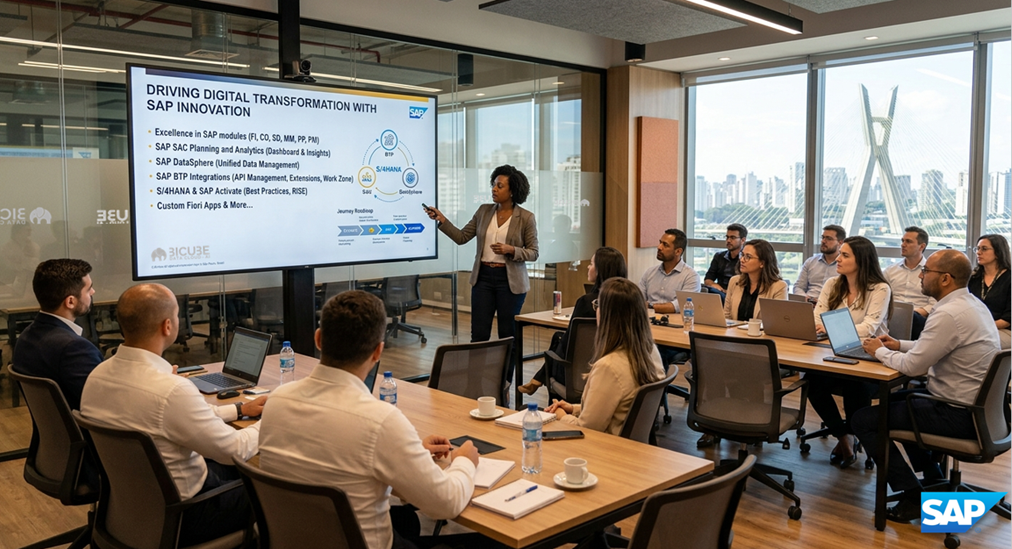
While the market seeks to understand the application of technology in processes, we offer effective digital transformation. We do this through solutions that combine technology, business and innovation, taking our clients to a new level of operational intelligence.
Our consultancy services thrive on strong partnerships with our customers and our partners. For us, partnership means supporting each other in the best possible way in good times while remaining loyal and standing side-by-side during difficult times. We have already demonstrated this on numerous occasions and our partners appreciate this.
SAC Analytics Cloud Training online by BICUBE is an extensive course covering every area of SAC, with a key focus on the BI practicality. Gain better knowledge about building and navigating stories along with an additional specialization in the digital room with our SAC Analytics Cloud online program. Learn all the four pillars of SAC - BI Stories, predictive analytics, planning, and analytic designer - to prepare for the SAC Analytics Cloud certification exam. Enroll now and unlock career-opportunites by learning SAC Analytics Cloud with industry experts.
SAP Datasphere is an integrated and persona-driven data warehouse-as-a-service solution that helps business and IT users better understand and analyze their business data. You can use it to access and explore semantically rich data from any source, integrate new information, and share new insights. Discover how you can use this tool to help businesses transform into data-driven enterprises.
The course covers the new solution SAP BW4/HANA and is focused on the new handling and functionality changes from SAP BW powered by SAP HANA to SAP BW/4HANA. Significant topics are the Data Warehousing concepts, mixed scenarios (including SAP HANA HDI), Data Services (CDS) based on extraction from S/4HANA, and the Data Tiering Optimization (DTO). This is a delta training from BW powered by SAP HANA (SAP BW on HANA) to SAP BW/4HANA. Please use training for delta from SAP BW on any DB to BW/4HANA.
The SAP Build Process Automation certification validates a professional's ability to understand and utilize SAP's technology for automating business processes. It confirms the individual's proficiency in designing, implementing, and managing Workflow automation using SAP tools, ensuring they can efficiently streamline operations within an organization. Industries leverage certified experts to enhance operational efficiency, reduce manual errors, and speed up process execution by automating repetitive tasks and complex workflows. The certification covers areas such as Process modeling, Digital forms creation, and the Integration of process automation with SAP's ecosystem, providing companies with the expertise needed to achieve digital transformation and improve process excellence.
With BICUBE's SAP Document and Reporting Compliance Training, SAP professionals will understand the complete solution that allows them to create, process, and monitor transactional documents and periodic regulatory reports across different countries or regions. SAP Document and Reporting Compliance (formerly SAP Document Compliance and SAP Advanced Compliance Reporting) offers a single solution to meet and manage your compliance reporting, e-invoicing, and document exchange requirements.
BICUBE is a consulting firm focused on SAP BI and Analytics issues, both for SAP Projects and for specialized SAP Training. We not only understand how the system works, but also how best to train your team. Using a combination of tools and methods, BICUBE training consultants have the expertise to help ensure that your workforce adopts the new software and any changes in business processes. Our training consultants have experience in developing customized, client-branded collaborative learning solutions for all SAP Analytics workflows, including Training and support in various SAP modules. Participate in our various SAP training courses and qualify for the various SAP Analytics Certifications.
A customized BICUBE training program, developed based on your specific structure and incorporating your business processes. Or we use our specific SAP environments for training and capacity building. Total flexibility to choose which training modules will be developed remotely and which ones to outsource to BICUBE. No limits on the number of participants per training session. Our online delivery, supplied via Microsoft Teams, Zoom, or any client-preferred tool, simplifies the issue of end-users being geographically dispersed. This allows us to offer a highly cost-effective, incredibly efficient training course to any end-user, anywhere in the world. This delivery option offers a dynamic, interactive web-based environment with managed audience participation, extending the reach without the requirement for additional ERP training consultants.

By participating in our SAP training in Analytics scenarios, professionals develop practical skills in using SAP Analytics tools to improve data analysis and support strategic decision-making, contributing to the generation of valuable insights and increased efficiency in business processes. In addition to understanding how to act on data structures and their volume and performance management.
In terms of DRC, professionals are trained in Mastering digital tax compliance processes, Reducing non-compliance risks, Increasing efficiency and automation, and Acting as a strategic reference.
In today's fast-paced digital transformation landscape, companies that aim to stay competitive must go beyond simply adopting new technologies. They need to rethink processes, business models, and how intelligence is applied in daily operations. In this context, BICUBE Cloud stands out by offering a robust and flexible platform to harness the full potential of Generative AI in crafting innovative and highly adaptive strategies.
-
-
BICUBE is here to assist you in implementing your BICUBE ANALYTICS PLATFORM, handling the architectural and conceptual aspects, often in collaboration with your internal resources. We are also available to build your data models upon request. A fundamental aspect of the architecture is integration with any existing SAP or non-SAP database.
The BICUBE ANALYTICS PLATFORM is fully scalable to the needs of different departments within the company, integrating data governance and democratization. It is fully customized according to the needs of each department and user.See the video demonstration. The BICUBE ANALYTICS PLATFORM is available in three languages: Portuguese, English, and French.
n8n ("nodemation") is an open-source process automation and systems integration platform. It works as a low-code/no-code workflow orchestrator, allowing you to connect APIs, databases, SaaS applications, and Artificial Intelligence without the need for extensive programming.
BICUBE Cloud AI can act as a strategic enabler in the integration and use of N8N with SAP, offering solutions that enhance automation, data intelligence, and operational efficiency for customers. Here's a detailed description of how it works:
BICUBE Cloud AI allows you to create automated workflows between SAP systems (such as S/4HANA, SAP BTP, and SAP Analytics Cloud) and various external applications using N8N, without the need for complex programming. It enables real-time data integration, eliminating manual processes and reducing errors. Integrating GPT, Excel, Gmail, SalesForce, Slack, HubSpot, Power BI, SAP BTP and many others.
Automation of repetitive tasks, such as:
| Updating sales orders;
| Sending financial reports;
| Automatically creating and classifying tickets in SAP Service Cloud.
Allows teams to focus on strategic decisions, while N8N orchestrates the processes in the background.
BICUBE Cloud AI adds intelligence to N8N workflows by applying predictive analytics, NLP, and LLMs to SAP data.
For example, identify sales patterns or forecast demand before critical decisions are made.
Connects data integrated by N8N directly to Power BI or SAP Analytics Cloud dashboards, allowing managers to view information in real time.
Supports automatic alerts and strategic KPI monitoring.
BICUBE Cloud AI ensures that data transferred through N8N maintains quality, consistency, and compliance.
It facilitates the maturation of data use within the organization, promoting more reliable and sustainable decisions.
The combined use of BICuBE Cloud AI and N8N allows you to:
| Scaling processes without major IT investments;
| Quickly adding new flows and integrations;
| Adapt automation to changing business needs.
Our dashboard insights product combines the best of BICUBE Platform, Power BI and SAP SAC, to transform data into strategic decisions.
First, we offer unified and flexible integration, connecting to any data source and automating processes to reduce manual effort. Second, we deliver analytical, generative intelligence, and actionable insights, with dynamic dashboards and predictive analytics that reveal opportunities and risks in real time. Third, we prioritize user experience and collaboration, with intuitive interfaces, cross-platform access, and features that facilitate information exchange between teams. Finally, we guarantee governance, security, and scalability, ensuring performance, compliance, and sustainable growth. With these four pillars, we empower your company to see what truly matters and act with confidence.SEE THE DEMO BELOW - (Continuous data in insights is for demonstration purposes only)
Cloud technology, combined with generative intelligence, is revolutionizing the way we create value from data. With the cloud, we achieve scalability, flexibility, and cost reduction by accessing resources securely and on demand.
Generative intelligence expands our capacity for innovation, transforming large volumes of information into insights, automation, and creative solutions. Together, these technologies enable companies to act faster, personalize experiences, and anticipate needs, strengthening decision-making and market competitiveness.
SAC can be used as a self-service tool for business users. Self-service features allow users without programming skills to easily create analyses and reports through stories and templates.
This capability empowers the business domain to generate insights through SAC’s “Just Ask” AI-driven automation.
For optimal performance, we believe IT should play a supportive role, using technical expertise to guide and review the development process.
Datasphere Spaces empower business users to model distinct data areas and define data products autonomously. These protected spaces independently manage resources, connections, data, and access, promoting data democratization while ensuring stability. Additionally, using separate spaces allows for costs to be distributed across different departments.
Use the Data Marketplace to facilitate data exchange within your company or with external partners.
Datasphere supports a broad range of source system types, making data integration straightforward. If additional integration is needed, the SAP Integration Suite provides a robust complement. Through Semantic Onboarding, Datasphere retains the context of source systems, enhancing usability. Integration in Datasphere goes beyond data consumption; it also supports data sharing with other systems, such as data lakehouses like Databricks.
With its partnership with Collibra, Datasphere offers comprehensive data governance across both SAP and non-SAP systems. Technologically, Datasphere is powered by the high-performance SAP HANA Cloud, complemented by the SAP HANA Data Lake. Together, they support advanced analysis of unstructured data with the Vector Engine, as well as enhanced AI applications. Structured data queries benefit from reduced inaccuracies thanks to the Knowledge Graph, which adds contextual connections and automatically networks data. These advancements make Datasphere more accessible to a broader audience than a traditional Data Warehouse. Datasphere’s users are no longer just report recipients or planners—Data Scientists can now access raw data, work with Python or R, and leverage AI. With these new AI-driven capabilities, data quality becomes even more essential. Datasphere acts as the core of a Data Fabric strategy, providing reliable data products. This shift, however, requires a cultural change and new responsibilities within organizations, as data silos need to be dismantled.
SAP Datasphere is not simply a new version of SAP BW in the cloud—it represents a transformative shift for SAP’s analytics landscape. The synergy between SAP’s Business Technology Platform (BTP) and Datasphere unlocks maximum value for both end users and IT teams.
BICUBE is here to assist in your SAP Datasphere implementation, handling architectural and conceptual aspects, often in collaboration with your internal resources. We’re also available to build your data models upon request.
A key consideration in architecture is integrating with any existing SAP BW system and other SAP BTP services.
When building a scalable SAP Datasphere solution, a comprehensive storage and authorization concept is critical, an area where our project experience plays a pivotal role.
While SAP Datasphere is not a new version of SAP BW, it can extend and, in some cases, replace SAP BW. For organizations with an established SAP BW landscape, it makes sense to evaluate a transition to SAP Datasphere. The SAP BW Bridge, for instance, is useful for migrating or consuming existing SAP BW data flows within the Public Cloud (SAP BTP). However, this is not a strict requirement, as SAP BW can also serve as a standalone data source for SAP Datasphere.
We’d be happy to consult with you and provide a demo to showcase what SAP Datasphere can do and how to leverage it effectively.
We collaborate with you on key decisions during SAC implementation, including file and permission management, logins, authentication, story templates, and more.
Through targeted training, we equip your colleagues in both IT and business units with SAC expertise and guide them through creating initial stories.
Depending on the chosen approach, we can develop a tailored authorization concept that suits your story-creation process.
Some stories require advanced technical skills and may not be suitable for self-service. Our experts are ready to assist in building these applications efficiently and reliably.
SAP Analytics Cloud is a self-service business analytics tool that enables both data analysis and visualization of current conditions, while also supporting intelligent planning through its extensive forecasting tool. SAC further enhances capabilities with predictive analytics and AI. Leveraging SAP HANA’s in-memory technology and machine learning, SAC enables real-time forecasting. Its unique combination of planning and analysis empowers users to plan based on existing data and write back directly into systems. Since its launch in 2015, SAC has rapidly evolved, with its planning features setting it apart.
As the name implies, SAC is fully cloud-based, offering flexible access to data without the need for software installation on the client side. When data is already in BTP—preferably in the Data Fabric, built with SAP Datasphere—integration with SAC is seamless.
SAC can be used as a self-service tool for business users. Self-service features allow users without programming skills to easily create analyses and reports through stories and templates.
This capability empowers the business domain to generate insights through SAC’s “Just Ask” AI-driven automation.
For optimal performance, we believe IT should play a supportive role, using technical expertise to guide and review the development process.
SAC is highly versatile and can function as a standalone frontend tool for purely graphical representations of data sourced from other systems. For example, with a live connection to SAP BW, authorizations can be managed solely within the source system, and data replication to the cloud is unnecessary. However, this approach comes with limitations, as users can no longer enrich the data or use planning functions.
Organizations can gather massive datasets from various sources and store them in the Data Lake, enabling extensive analysis and valuable insights.
Long-term data storage in the Data Lake allows companies to meet legal and regulatory requirements without incurring high costs for primary storage solutions.
Data stored in the Data Lake can be utilized for machine learning models to make predictions and enhance decision-making processes.
SAP HANA remains a core component of SAP products requiring data storage, such as SAP Datasphere or ERP solutions. SAP HANA Cloud continues to evolve, adding features like the Data Lake. Read on to discover the capabilities that SAP HANA Cloud, including its Data Lake, offers and how you can benefit from our expertise.
SAP HANA Cloud provides various storage types that differ in speed, cost, and capacity. This multi-tier storage model offers tailored storage solutions for diverse application needs. The following graphic illustrates the interplay of each component and their respective strengths.
The SAP HANA Cloud Data Lake is an extension of SAP HANA Cloud, specifically designed for storing and managing large volumes of data. It provides a cost-effective solution for storing both structured and unstructured data in a single, centralized repository. This makes it ideal for big data scenarios where large datasets are collected, stored, and analyzed.
We assist you in configuring Business Application Studio and Build Code to meet your specific needs.
We offer training for your development team to maximize tool usage.
Our team provides ongoing support and maintenance for your development environment.
SAP BTP and the Business Application Studio offer a comprehensive, high-performance environment for developing, debugging, and deploying business applications. The SAP BTP “Build Code” service enhances the BAS-based IDE with tools for creating and managing code in an agile, collaborative environment. Leveraging Artificial Intelligence (AI) and the SAP AI assistant, Joule, the implementation process can be further optimized and accelerated. Our service covers the full development cycle, from the first line of code to cloud deployment.
SAP Business Application Studio: The ideal development environment for efficient creation of business applications.SAP Build Code: A suite offering version control, code review, and automated builds in a collaborative setting.
A modern, integrated development environment (IDE) that combines the best features of Visual Studio Code with SAP-specific tools, providing an ideal platform for developing business applications.
Build Code empowers developers to work productively in an agile environment. Equipped with tools for version control, guided programming, code reviews, and automated builds, developers can optimize their workflows.
AI - With SAP Copilot Joule, AI capabilities are embedded directly into the Business Application Studio, enabling faster coding and reducing errors. These tools analyze code and provide intelligent suggestions for optimization and troubleshooting. Joule helps developers identify and resolve potential issues early, shortening development cycles and enhancing application quality.
Application of complex business logic to replicated data, even in real time.
Data modeling.
Performance optimization for both data loading and data analysis.
Flexible and scalable authorization concepts.
Integration with SAP Datasphere.
Connection to reporting systems and additional data consumers, such as SAP Analytics Cloud.
Data Tiering Optimization (hot, warm, cold).
SAP Build Process Automation is part of the SAP Build Suite, focusing on workflows and digital assistants. A staggering 72% of finance teams spend up to 10 hours per week on tasks that could be automated.
We’re Here to Support You!
Much like a sports car optimized over decades, SAP BW has matured into a refined and reliable product in its latest version, SAP BW/4HANA. Current use cases for SAP BW primarily involve areas where reliability, robustness, and stability are critical. Additionally, SAP BW/4HANA offers exceptional performance and can be more cost-effective than cloud solutions.
We believe that companies with a long-standing investment in SAP BW should also benefit from the advantages of cloud solutions. However, it is equally important to carefully assess which use cases justify a transition to the cloud—and which do not. Learn more in our resources on Data Warehouse Modernization and Datasphere.
With hundreds of successfully completed projects for large enterprises and mid-sized businesses, BIG.Cube is a leading expert in SAP BW. The creativity and expertise of our consultants, combined with over ten years of experience, allow us to deliver the best possible advice.
Everyday work offers countless opportunities for automation. Below are some suggestions for automation across various areas and how it can help you improve efficiency on a fundamental level.
We help you choose the correct views.
We support the architectural integration within your analytics landscape.
We guide you through development and implementation.
We provide support with Fiori development.
80% of the effort in a typical analytics project involves re-establishing context. Embedded Analytics enables analysis directly at the source of data but is suited only to specific use cases. Below, you’ll find what’s essential for implementation and how you can benefit from our expertise.
Embedded Analytics is sometimes also associated with Embedded BW, which, however, is not covered here as it is still based on BW 7.x and is no longer actively developed. Embedded Analytics is built on a virtual data model created through CDS Views, which can then be accessed by various frontends. Typically, this includes Fiori frontends, although other technologies and tools are also possible. Embedded Analytics can be seamlessly integrated into the analytics architecture, allowing extensions with additional apps, such as those running on the Business Technologie Platform (BTP).
Real-time analytics directly within SAP S/4HANA
Pre-configured, out-of-the-box content
Interactive, real-time reporting and data analysis
Seamless integration with existing SAP processes
Self-service reporting for end-users
No data replication, as everything operates within the core system
User-friendly dashboards and intuitive reports
Direct use of Fiori apps for data-driven decision-making
Role-based "overview pages" and dashboards
Insight-to-action capability for both analysis and resolution
Optimized business processes within ERP through deeply integrated operational analytics
Embedded Analytics in S/4HANA enables data analysis within the S/4HANA system itself, but not all analyses are possible or practical through this approach.
Embedded Analytics may be worth considering when:
No data from other systems is required
A narrowly defined analysis timeframe is chosen
Query load on the system is low
This means that specialized analytics solutions are necessary when more than one system is involved, or when complex analyses are needed. It’s essential to account for the system load generated by queries when determining which reporting can occur in the operational system.
sing a dedicated analytics system alleviates load on operational systems. SAP offers BW/4HANA, the NetWeaver-based classic, and the modern strategic Datasphere, both of which integrate smoothly into your analytics landscape.
In implementing Embedded Analytics, we’ve identified and addressed various challenges.
the right architecture—where and how analytics should be conducted—is a critical decision.
Many CDS views are available, and their definitions can change, so selecting stable views is essential.
Be aware of the technology’s limitations and determine which analyses you will permit in the operational system.
Together we answer the important questions at the beginning: What is the basic customer requirement? Are there already interfaces defined by SAP? Can the use case be integrated into an existing application? Does a completely new application have to be implemented?
Based on the requirements analysis, we create a prototype in the case of a new application using SAP Build. This serves to define the requirements in more detail and shows in the early project stage whether one is on the right track.
The agreed prototype is transferred into a concept, potential interfaces are identified and tested by mini-PoCs, and new interfaces are defined and formulated.
If the concept meets the customer’s requirements, the actual application including its interfaces is implemented and then deployed.
After successful implementation, the application is now tested by the customer and fine-tuned if necessary. Once this phase is completed, the new application can go live.
SAP Fiori is a concept with uniform design principles on how a user interface should be presented across all SAP applications in terms of graphical and functional elements. The SAP Fiori Design Guidelines define all the basic elements, such as how SAPUI5 elements and Fiori Launchpad should be used in the development framework.
SAPUI5 provides the basis for various products and solutions in the SAP environment. Essentially, SAPUI5 is a programming framework and a collection of elements and tools that are required for the development of SAPUI5 applications. SAP Fiori, on the other hand, is a user experience guideline for all SAPUI5 applications. The aim is to create a modern, uniform and user-friendly interface through the SAP Fiori Guidelines in order to enable users to operate business processes more easily and quickly.
Within the SAPUI5 framework there are various tools and techniques to develop SAP Fiori applications with little effort.
User inputs, e.g. for inputs, drop-down elements and forms
Visualisations, e.g. for texts, labels, tables, lists and images
Actions, e.g. for buttons, menus, file uploaders and links
SAPUI5 offers the ability to carry out data binding on different models. The simplest and best integrated variant are the oData Models. These can be applied to aggregations within various controls (e.g. table) and thus automatically display the corresponding contents within the table based on the oData Service.
The concepts of routing and navigation within a SAPUI5 app can be used to build SinglePage applications in which navigation can be mapped without having to reload the entire page. Specific route patterns as well as parameters can be included in the URL.
For automated testing of SAPUI5 applications, the two test frameworks QUnit and OPA5 are integrated. QUnit makes it easy to write unit tests, while OPA5 is best suited for component tests.
With SAP FIORI Elements, FIORI apps can be developed more quickly and cost-effectively by leveraging templates and features of standard applications. SAPUI5 code is automatically generated based on the metadata and annotations defined in Core Data Services (CDS).
The UI5 Web Components project provides a comprehensive set of enterprise-grade, reusable UI elements built on the Web Components standard. UI5 Web Components are fully compatible with both current and future web development frameworks, such as React, Angular, and Vue, enabling seamless integration into any technology stack.
Embedded Analytics in S/4HANA enables data analysis within the S/4HANA system itself, but not all analyses are possible or practical through this approach.
Embedded Analytics may be worth considering when:
No data from other systems is required
A narrowly defined analysis timeframe is chosen
Query load on the system is low
This means that specialized analytics solutions are necessary when more than one system is involved, or when complex analyses are needed. It’s essential to account for the system load generated by queries when determining which reporting can occur in the operational system.
sing a dedicated analytics system alleviates load on operational systems. SAP offers BW/4HANA, the NetWeaver-based classic, and the modern strategic Datasphere, both of which integrate smoothly into your analytics landscape.
In implementing Embedded Analytics, we’ve identified and addressed various challenges.
the right architecture—where and how analytics should be conducted—is a critical decision.
Many CDS views are available, and their definitions can change, so selecting stable views is essential.
Be aware of the technology’s limitations and determine which analyses you will permit in the operational system.
Data stewards play a crucial role in ensuring that an organization’s data assets remain accurate, consistent, and compliant with relevant regulations, particularly during company projects.
Data quality management encompasses the processes and procedures employed to maintain the integrity of an organization’s data assets, ensuring they are free from errors and inaccuracies. It also involves techniques for identifying and rectifying any errors or inaccuracies that may arise.
Data management processes establish how an organization’s data assets are generated, stored, accessed, and utilized. These processes also set the guidelines for sharing these assets with both internal and external stakeholders.
This component pertains to the hardware and software systems used for data collection, storage, and management. It includes databases, enterprise resource planning systems, data warehouses, and network connections that facilitate the exchange of information among stakeholders.
A data governance framework encompasses a set of regulations, processes, and responsibilities designed to guarantee privacy and adherence to regulations within an organization’s management of enterprise data. Even as the volume of data continues to grow, a data governance framework facilitates the following:
Efficiently expand and standardize core data governance practices. Sustain compliance with policies and regulations. Enable wider access to data. Foster collaboration among stakeholders. This framework offers a clear roadmap for ensuring the quality, integrity, security, discoverability, accessibility, and usability of an organization’s data assets. By implementing the appropriate framework, businesses can transform their data into a valuable, influential asset capable of meeting and potentially surpassing their business objectives and goals.Without the establishment of a data governance framework, businesses cannot ensure data quality or compliance with privacy regulations. This leaves them vulnerable to mishandling customer data, potentially leading to severe legal consequences such as substantial fines and harm to their reputation.
In the absence of a data governance framework, different departments within an organization tend to adhere to their own standards and procedures, which ultimately give rise to data silos. These silos, over time, lead to operational inefficiencies. Rather than having access to a centralized, reliable source of information, employees are restricted to the data confined within their respective tools and systems. This situation results in gaps in understanding and, at times, discrepancies in reporting across databases. Consequently, it erodes trust in the data as a whole.Before we dive into specific examples of data governance frameworks, we should first touch on the five main data governance models. The models are based on how data governance decisions will flow through your organization.
An effective enterprise data governance framework should:
With SAP DRC features, you can benefit from more standardized processes in your company. The system offers global management of electronic documents and statutory reports. This way, the user can achieve greater compliance through standardization and efficiency in automation.
SAP DRC enables you to create scenarios using your data or partner ecosystem to meet your business needs, working towards a unified user experience and simplified operations.
With SAP DRC, it is possible to centralize several activities – such as automatic error monitoring, transaction identification to enable continuous corrections, and communication of rejections to authorities. This way, it is possible to work with fewer compliance failures.
With SAP DRC, you can easily comply with legal requirements, even when they are constantly changing. In addition, the company can migrate periodic external reports for continuous transaction control with an integrated solution.
SAP DRC (Document and Reporting Compliance) is an SAP software tool designed to meet Brazilian tax obligations in SAP S/4HANA, formerly known as Advanced Compliance Reporting (ACR). In practice, it allows you to optimize automation, minimizing the risk of compliance failure – from electronic documents to statutory reports. To this end, SAP DRC works with the storage of data and technical information in the cloud, which makes processes more agile in the company's daily routine. The SAP DRC platform also facilitates communication between the company and the State Treasury (SEFAZ) and some city governments. Thus, with direct communication, the company's operations are optimized.
By using SAP DRC, companies can automate freight processing in SAP more efficiently and with less manual interaction in CT-e. Managing CT-e (Electronic Bill of Lading) can be very time-consuming for professionals in organizations. After all, we are talking about a fundamental document in freight operations for sales delivery, product returns, return shipping, among others.
SAP technology processes these freight items individually. However, with BICUBE's CT-e Launch Automation solution, it is possible to process various types of freight items with optimizations that reduce user interaction. With this CT-e automation, it is possible to have automatic routines that monitor steps with external actions and continue the launch flow automatically when the external actions are completed. In other words, more autonomy for your business operations.Additionally, you can also count on customized CT-e validations as needed:
Shipping cost; Shipping already posted for invoices referenced. Incoterm of invoices. Among others.With the need to transition to new platforms, it is vital to have a partner by your side who not only understands the SAP environment, but also has the expertise to guide your company through these changes successfully. At BICUBE Cloud IA, we are experts in SAP solutions in the cloud. We understand that changes like these can seem challenging, but with the right support, your business will not only adapt but thrive in this new technological landscape, and we are here to ensure your transition is as smooth as possible.